The chemical nature of plastic – Polymerization kinetics
Polymerization kinetics will be briefly discussed here to highlight key technological points. Due to the complexity of the topic, certain simplifications will be made. Readers interested in a more in-depth understanding of polymer chemistry kinetics should consult more comprehensive studies.
In a straightforward free radical-initiated addition polymerization, the primary reactions include (assuming termination by combination for simplicity)

Where M, I, M-, and I- represent monomers, initiators, and their radicals, respectively, with each initiator yielding two radicals.
The rate of initiation, denoted as Vi, i.e., the rate of formation of growing polymer radicals, can be expressed as…

In the provided context, the variable “f” denotes the initiator efficiency, representing the fraction of radicals that successfully initiate polymer chains. The concentration of initiators is denoted by [I]. The propagation rate hinges on the concentrations of growing polymer chains ([M-]) and monomers ([M]). Given that this rate essentially signifies monomer consumption, it concurrently serves as the overarching measure for the polymerization process.

In cases of mutual termination, the pace of the reaction is influenced by the concentration of active radicals. This phenomenon is second-order in nature, given that each termination event involves the participation of two radicals.

In practical terms, it is observed that the concentration of radicals quickly stabilizes, leading to a steady state in the reaction. Consequently, the rate of radical formation (V) equals the rate of radical disappearance (V). This allows the combination of equations (1) and (3) to derive an expression for [M-] in relation to the rate constants.

Substituting this into Equation 2.2 yields…

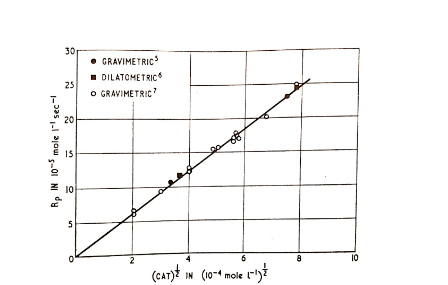
This equation indicates that the reaction rate is proportional to the square root of initiator and monomer concentrations. While the correlation with initiator concentration is typically observed in practice (see Figure 1), deviations may arise with monomer concentration, attributed to the influence of f on monomer concentration, especially at low efficiencies, and the effects of certain solvents in solution polymerizations.
The average kinetic chain length (r) is the number of monomer units consumed per active center formed, expressed as R/V (or RJV). Combining equations (1) and (5) results in…

Elevating initiator concentration enhances polymerization rate but diminishes molecular weight, as indicated by equations (5) and (6). In various polymerizations, transfer reactions to modifiers, solvents, monomers, and initiators may occur. Although the overall propagation rate remains unchanged, these additional termination pathways for growing chains lead to a decrease in the degree of polymerization.
The polymerization degree can also be represented as:

For transfer modes involving a single reaction of the type

The rate equation, where [S] represents the concentration of the transfer agent SH, is
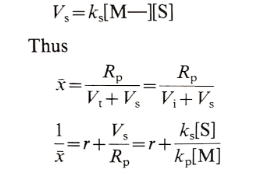
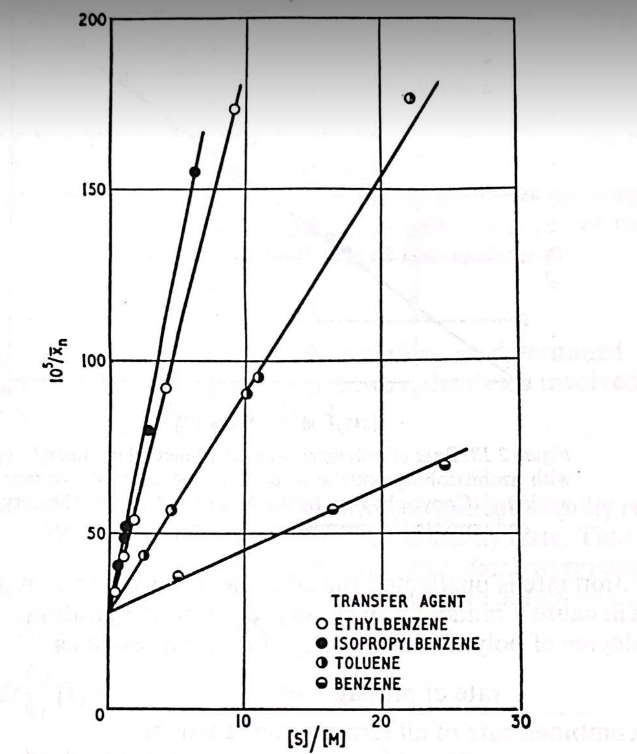
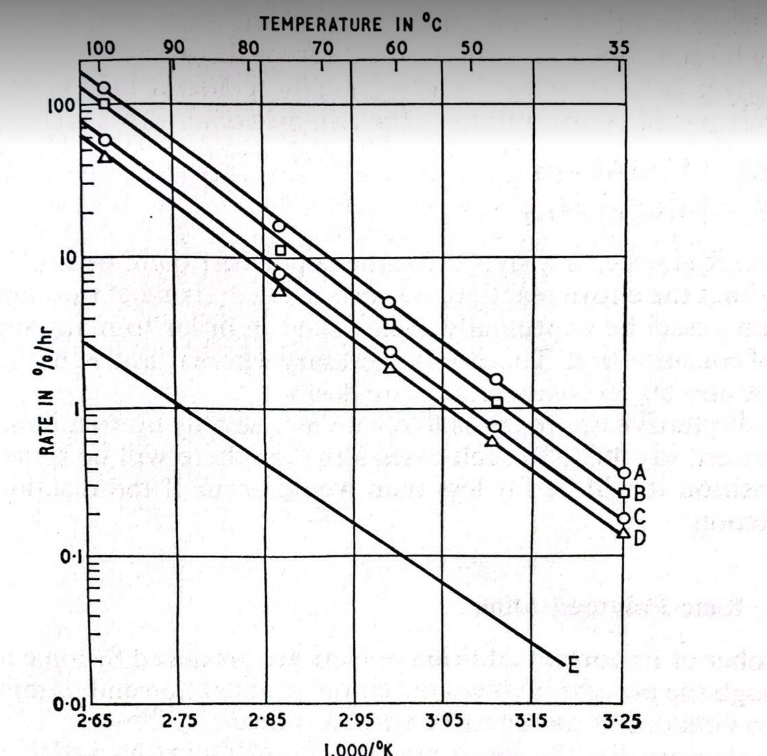
Higher transfer rate constants and transfer agent concentrations lead to lower molecular weights, as illustrated in Figure 2. Elevated temperatures result in increased values for the rate constants kd, kp and kt, and in free radical polymerizations, the conversion rate approximately doubles for every 10°C temperature rise (refer to Figure 3). Consequently, due to the inverse relationship between molecular weight and rate constants, an increase in temperature generally leads to a decrease in molecular weight. In summary, kinetic studies suggest that technological implications include the impact of transfer rate constants, concentration of transfer agents, and temperature on polymerization processes.
(1) Polymer molecules form almost instantly once an active center is established. The reacting system concurrently contains monomer, complete polymer, and a small amount of growing radicals. Extended reaction times primarily increase monomer-to-polymer conversion, with minimal impact on the degree of polymerization. However, at high conversions, the viscosity of the medium may hinder termination, resulting in polymers formed towards the end of the reaction having slightly higher molecular weights.
(2) Higher initiator concentration or temperature increases the conversion rate but decreases molecular weight.
(3) Transfer reactions decrease polymerization degree without affecting the conversion rate.
(4) The reaction’s statistical nature results in a distribution of polymer molecular weights. Quoted molecular weight figures represent different averages. The number average considers molecule counts of each size, while the weight average considers size fractions by weight. For instance, the presence of 17% monomer by weight has a greater impact on the number average than the weight average. The ratio of the two averages provides a measure of the molecular weight distribution.
In emulsion polymerization, about half of the micelles react simultaneously, making conversion rate relatively independent of radical concentration but dependent on the number of micelles (or swollen polymer particles). Increased radical production decreases molecular weight due to higher termination frequency, while a greater number of particles raises molecular weight and conversion rate.
Copolymerization kinetics are complex with the potential for four propagation reactions when two monomers are present.

Since these reaction rarely take plasce at the same rate one monomer will usually be consumed at a different rate from the other.
If kaa/kab is denoted by ra and kbb/kba by rb then it maybe shown that the relative rates of consumption of the 2 monomers are given by

To ensure a constant copolymer composition throughout the reaction, it’s essential to continually replenish one of the monomers in the reaction vessel, particularly when r1 and r2 deviate from unity, and a 50/50 composition is sought. However, in cases where r1 andr2 are both close to unity and a balanced composition is acceptable, continuous replenishment is less critical.
An alternative approach is to limit copolymerization to a specific degree of conversion, such as 40%. Although some composition variation may occur, it is significantly less than what would result from completing the reaction.
